Corporate Governance

Corporate Governance

At Lotus, we uphold strong corporate governance in line with our Corporate Governance Best Practice Principles, safeguarding stakeholder rights, strengthening Board oversight, ensuring independent directors fulfill their duties, and enhancing transparency through timely disclosures.
Section ImageSection ImageSection Image

Board Operation

Board Diversity

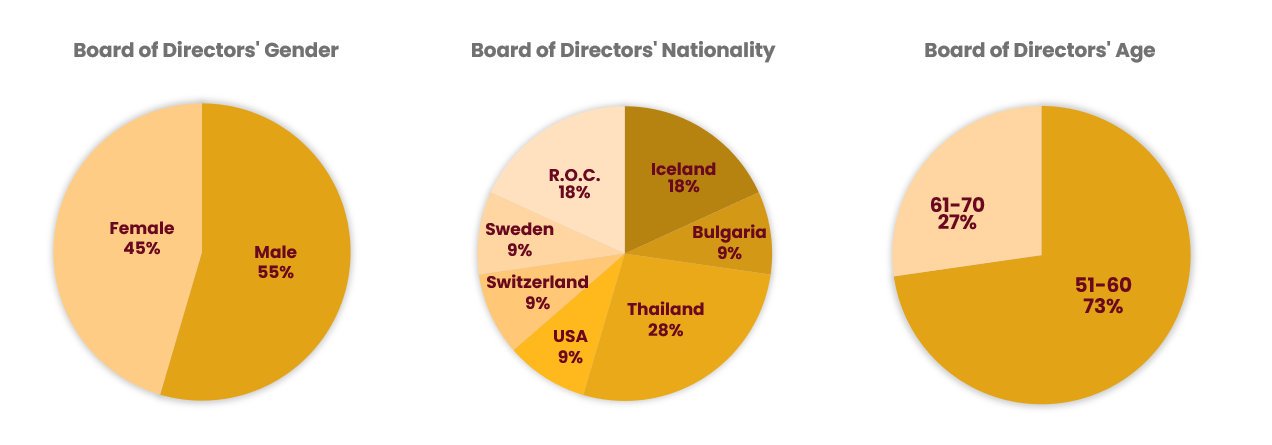
The Board of Directors prioritizes professionalism, diversity and independence in its composition.

  • Professionalism: Lotus places particular emphasis on ensuring that Board Members possess financial expertise. The company has set a target of 40% of directors with financial expertise, and the current proportion is 45%.
  • Diversity: Lotus directors hail from seven different countries and female directors constitute 45% to the total Board.
  • Independence: Lotus  adheres  to relevant laws, ensuring that its directors do not fall under any of the situations outlined in Article 30 of the Company  Act; additionally, neither they  nor their spouses  or underage children hold shares in the Company. There are 3 independent directors, none of whom have served for three consecutive terms, accounting for 27% of the total directors. The company’s single corporate director seat does not exceed one-third of the board, with the remaining seats held by individual directors.

In 2025, Lotus held a total of 12 board meetings, with an average attendance rate of 98.5% for all directors. The actual attendance rate, excluding proxy attendance, was 91.7%. 


Succession Planning & Operations

Lotus has established a succession planning system to maintain the professionalism and experience of its board members and senior management.


BOARD MEMBERS

During board's tenure, each board member is required to complete at least 6 hours of continuing education annually to help them continuously update their knowledge and maintain their core values, professional advantages, and abilities.
To ensure effective corporate governance and improve the functioning of the Board, in accordance with the Company's "Procedures for Performance Evaluation of the Board of Directors," an internal performance evaluation of the Board is conducted at least once a year. Furthermore, at least once every three years, the evaluation should be performed by an external independent professional institution or an expert panel. Through this performance evaluation mechanism, the effectiveness of the Board's operations is ensured, and the evaluation results serve as a reference for the reappointment of current board members and the selection of new candidates for future succession.


KEY MANAGEMENT PERSONNEL

The specific approach and implementation of the succession plan are as follows:
  • Executive Strategy Management Meetings: The executive regularly holds strategy formulation and execution meetings with senior executives of each function to ensure the achievement of the company's objectives.
  • Talent Inventory Execution: The Company effectively tracks the professional competencies and talent development within the organization (including department heads, deputies, and key position candidates). Based on competency gaps and the company's operational needs, relevant training programs are planned to ensure sustainable talent management.
  • Functional heads nominate potential successors, thereby building a talent pool for the development of the management team.
  • Annually, the Company conducts personality attributes and leadership style assessment for employees who demonstrated strong performance and development potential, to identify development areas and arrange, coaching programs accordingly. The individual development plans of each talent will be ensured to be in alignment with the annual objectives. Readiness for future succession is regularly reviewed.
  • Lotus' proactive business expansion strategy also offers valuable experience in project management and fosters cross-unit communication and collaboration skills, leading to successful outcomes. Notable examples include the acquisition of TEVA PHARMA (THAILAND) CO., LTD. in 2024 and securing of a pharmaceutical license in Vietnam from Sanofi.
  • Based in Taiwan with a global perspective, Lotus' talent development strategy at its headquarters is highly competitive, nurturing global management professionals.

Board & Functional Committees Performance Evaluation Results

2024
Evaluation Cycle
The Company completed the performance evaluation of the board and functional committees in 2024 through "Taiwan Investor Relations Institute (TIRI)" to be dealt with by means of external evaluation. The association has appointed Ms. Nancy Hsu as a director, Mr. Jack Chang as a director, and Mr. Ken Lin as a lawyer to serve as members of the evaluation committee. They have all declared their commitment to maintaining impartiality, objectivity, and independence in assessing the performance of the board of directors of Lotus, including its functional committees.
Evaluation Period
From Jan 1st, 2024 to Dec 31st, 2024
Evaluation Scope
The scope of the performance included the board, the Audit Committee, and Remuneration Committee.
Evaluation Method
The external rating agency requires the company to provide the documents specified by it, and distributes self-assessment questionnaires related to performance evaluation to all directors to fill in and return, and assigns 3 executive members to be responsible for the evaluation after issuing a declaration of independence to conduct online interviews with the company's chairman and independent directors, corporate governance officer, and audit supervisor conducted interviews and evaluations on Dec 16th and Dec 19th, 2024.
Evaluation Contents
The criteria for evaluating the performance of the Company's Board of Directors cover the following five aspects:
  1. Composition and professional development of the Board of Directors
  2. Quality of decision-making by the Board
  3. Operational effectiveness of the Board
  4. Internal control and risk management
  5. Engagement in corporate social responsibility (CSR)

The criteria for evaluating the performance of the functional committees cover the following five aspects:
  1. Level of participation in company operations
  2. Understanding of functional committee responsibilities
  3. Enhancement of decision-making quality within the committees
  4. Composition and member selection of the functional committees
  5. Internal control
Evaluation Results
Overall Evaluation: After interviewing the Chairman, the Chairperson of the Functional Committee, the Corporate Governance Officer, and the Audit Officer, TIRI commends the diversity and sound structure of the company's board members, who bring expertise from various countries and fields. The Board of Directors, the Remuneration Committee, and the Audit Committee all hold regular meetings, with good attendance from all directors and independent directors, who actively participate in discussions.

In response to future regulatory changes, it is recommended that the company further focus on its corporate governance structure and sustainable development performance.

TIRI's recommendations and our corresponding improvement measures are as follows:
  • Upgrading the sustainability and risk management team to a functional committee at the board level.
    LOTUS' IMPROVEMENT PLAN
    Risk management is merged into the Audit Committee, renamed the "Audit and Risk Committee" in 2025, and reports to the Board at least once a year on its implementation.
  • Ensuring that independent directors account for at least one-third of all board directorships.
    LOTUS' IMPROVEMENT PLAN
    The re-election of the Board of Directors in the next term will be included in the plan.
  • Reporting the implementation of risk management to the board of directors at least once per year.
    LOTUS' IMPROVEMENT PLAN
    Risk management is merged into the Audit Committee, renamed the "Audit and Risk Committee" in 2025, and reports to the Board at least once a year on its implementation.
  • Planning and formulating specific measures to enhance corporate values and reporting them to the board of directors.
    LOTUS' IMPROVEMENT PLAN
    Corporate Governance team planned to gradually disclose the relevant information by the end of 2025.
  • Disclosing the promotion of sustainable development and ethical management on the Company website.
    LOTUS' IMPROVEMENT PLAN
    The content had been disclosed on the Lotus website in January 2025.
  • Actively promoting environmental and social governance.
    LOTUS' IMPROVEMENT PLAN
    • Environmental
      • The first greenhouse gas emissions inventory and assurance were completed in KR & TW, with relevant information transparently disclosed.
    • Social
      • Two volunteer medical services were held in Nantou's rural areas in 2024
      • Supported dementia care training for migrant caregivers in Taiwan.
      • Donated hygiene products to low-income women and adolescents, shared bread, and donated kimchi for 12 consecutive years in Korea.
      • Encouraged subsidiaries to organize healthcare-focused public welfare activities, expanding positive impact.
 
2023
Evaluation Cycle
The Company completed the performance evaluation of the board and functional committees in 2023 through Internal self- evaluation.
Evaluation Period
From Jan 1st, 2023 to Dec 31st, 2023
Evaluation Scope
The scope of the performance evaluation included the board, individual directors, the Audit Committee and Remuneration Committee
Evaluation Method
The performance evaluation methods include self-evaluation of the Board of Directors, self- evaluation of the directors, and self-evaluation of the Audit Committee and Remuneration Committee
Evaluation Contents
The criteria for evaluating the performance of the Company’s Board of Directors shall cover the following five aspects:
  1. Participation in the operation of the Company
  2. Improvement of the quality of the Board of Directors' decision making
  3. Composition and structure of the Board of Directors
  4. Election and continuing education of the Directors
  5.  Internal control

The criteria for evaluating the performance of the Company’s directors shall cover the following six aspects:
  1. Familiarity with the goals and missions of the Company
  2. Awareness of the duties of a Director
  3. Participation in the operation of the Company
  4. Management of internal relationship and communication
  5. The Director’s professionalism and continuing education
  6. Internal control

The criteria for evaluating the performance of the Company’s Audit Committee and Remuneration Committee shall cover the following five aspects:

  1. Participation in the operation of the Company
  2. Awareness of the duties of the Functional Committee
  3. Improvement of the quality of the Functional Committee’s decision making
  4. Composition and election of the Functional Committee
  5.  Internal control
Evaluation Results
The administer of the Board delivered the self-evaluation questionnaire for the performance evaluation to each Director and member of the Audit Committee, Remuneration Committee and Sustainable Development Committee and recovered the questionnaires.
Based on the evaluation results, most of them were graded as excellent.
result of performance evaluation were presented to the board of directors on March 14th, 2023.

Functional Committees

Remuneration Committee

The Remuneration Committee assists the Board of Directors in reviewing Lotus' overall compensation and benefits policies and programs as well as in evaluation and compensation of Lotus' Directors and management team. According to Lotus' Remuneration Committee Charter, the Committee shall consist of no less than three members, including independent directors of the Board, and meets at least twice a year.


REMUNERATION COMMITTEE'S OPERATION

A total of 5 Remuneration Committee Meetings was held in 2025.
Title Name Actual Attendance Attendance By Proxy Actual Attendance Rate (%) Remarks
Independent Director Jennifer Wang 5 0 100%
  • Convener
  • Appointed upon June 13th, 2024 re-election
  • Attendance : 5
Independent Director Karl Alexius Tiger Karlsson 5 0 100%
  • Appointed upon June 13th, 2024 re-election
  • Attendance : 5
Independent Director Ivy Yang 4 1 80%
  • Appointed upon June 13th, 2024 re-election
  • Attendance : 5

EXECUTIVE PERFORMANCE EVALUATION SYSTEM

1. Purpose and Principles of the System

This system is designed to strengthen performance-oriented management for senior executives, ensuring that compensation is aligned with overall corporate performance, longterm strategic goals, and shareholder interests. The system is built upon the principles of fairness, integrity, and transparency, and incorporates both financial and non-financial indicators that reflect the company’s mission, sustainability strategy, and organizational development priorities.

2. Compensation Structure Disclosure

The compensation system for senior executives consists of three key components: base salary, short-term incentives, and long-term incentives. The design aims to balance market competitiveness, organizational stability, and long-term value creation.

Category Core Description Design Purpose
Base Salary Provides stable cash compensation based on role, skills, experience, market benchmarks, and internal equity Ensures fairness and stability in compensation, attracting and retaining senior talent aligned with the company’s strategy and values.
Short-Term Incentives The bonus are awarded based on annual financial performance indicators such as revenue growth rate and EBITDA, as well as non-financial metrics related to ESG. These include both company-wide and departmental performance targets. Each indicator is assigned a specific weighting, with performance tiers linked to corresponding bonus levels. If the overall achievement rate falls below target rate which defined by Company and approved by BoD, no bonus will be granted for that year. All awards are subject to review and approval by the Remuneration Committee. This system is designed to strengthen executives’ commitment to annual goals and sustainable development. Bonus levels are adjusted based on actual performance, aligning with shareholder interests and ESG commitments.
Long-Term Incentives

The company adopts equity-based incentive tools, currently in the form of Restricted Stock Awards (RSA), Treasury shares, and plans to gradually expand the long-term incentive mechanism. The vesting period is either 3 or 5 years from the date of contract signing. If individual performance and company business goals meet expectations, the granted shares will be vested over the 3 or 5 years period. Treatment of Unvested Shares Upon Termination

1) In cases of voluntary resignation, termination or retrenchment with cause(s): all unvested shares will be cancelled.

2) For leave of absence (e.g., maternity or parental leave): ≤ 3 months: counted as full-year service, >3 months: shares will be prorated based on actual service days

3) Retirement: all unvested shares will be granted on the date of confirmation

4) Death: all unvested shares will be granted on the date of confirmation

5) Permanent illness, incapacity, or disability (excluding cases due to drug or alcohol dependency): all unvested shares will be granted on the date of confirmation  

To align the interests of the core management team with those of shareholders, jointly committed to building long-term value for the company. To attract and retain outstanding talent capable of executing the business plans and key objectives defined by the Board of Directors and shareholders.

3. Performance Evaluation Criteria and Weighting

Evaluation Category Measurement Weightage
Financials
  • Revenue
  • EBITDA
70%
Non-Financials
  • Access to Medicines
  • Product Quality
  • Talent Attraction and Retention
  • Compliance
  • Climate Response Actions
30%

*Climate response action included only in responsible executives’ KPIs.

4. Alignment with Corporate Mission and Sustainability Strategy

The company’s non-financial performance indicators are closely integrated with its corporate mission and sustainability strategy, covering the following core dimensions:

Category Description
Environmental Responsibility Includes concrete actions such as carbon emission reduction, wastewater and waste management, and regulatory compliance to achieve environmental sustainability goals and address global climate risks.
Medicine Accessibility Committed to improving access to medicines in emerging markets, addressing unmet medical needs, and advancing health equity in line with the company’s mission.
Organizational Culture and Talent Development Enhances employee training mechanisms, improves retention rates, and promotes pay equity disclosure to foster an inclusive and sustainable workplace.
Stakeholder Engagement Maintains transparent and constructive communication with labor unions, government agencies, investors, suppliers, and customers to build trust and long-term partnerships.


Audit & Risk Committee

The Audit and Risk Committee assists the Board in overseeing the quality and integrity of the Company's accounting, auditing, financial reporting, and financial control practices. In response to international sustainability trends, the Committee has also incorporated climate risk-related information to further strengthen the Company's overall risk management.

According to Lotus' Audit and Risk Committee Charter, the Committee shall consist of all independent directors with no less than three members in total. The Committee meets at least once every quarter and is authorized to retain and oversee legal, accounting, or other consultants as it deems appropriate to fulfill its mandate.

AUDIT AND RISK MANAGEMENT COMMITTEE'S OPERATION

The Company held a total of 13 Audit and Risk Committee Meetings in 2025.
Title Name Actual Attendance Attendance By Proxy Actual Attendance Rate (%) Remarks
Independent Director Karl Alexius Tiger Karlsson 11 2 84.62%
  • Appointed upon June 13th, 2024 re-election
  • Attendance : 13
Independent Director Jennifer Wang 13 0 100%
  • Appointed upon June 13th, 2024 re-election
  • Attendance : 13
Independent Director Ivy Yang 12 1 92.31%
  • Convener of the 5th term
  • Appointed upon June 13th, 2024 re-election
  • Attendance : 13


COMMUNICATIONS OF INDEPENDENT DIRECTORS WITH INTERNAL AUDITORS AND CPAS

1 Policy on Facilitating Communication between Independent Directors, Internal Audit Director, and External Auditors

1.1 Communication with External Auditors
The company holds at least four regular meetings annually. External Auditors report to Independent Directors through Audit Committee meetings and Board meetings regarding the Company's financial performance, financial status and overall operations of domestic and overseas subsidiaries, and internal control audit situations. There is also thorough communication on whether there are significant adjustments in accounting entries or impacts on accounting due to legislative revisions. In the event of significant anomalies, meetings can be convened at any time. 
1.2 Communication with Internal Audit Director
The company holds at least four regular meetings annually. Internal Audit Director report to Independent Directors through Audit Committee meetings and Board meetings regarding the Company's internal audit execution and the status of internal control operations. In the event of significant anomalies, meetings can be convened at any time.

2 Summary of Communications between External Auditors and Independent Directors in 2025

Meeting Dates  Communication Content  Results
2025.03.03
Audit Committee Meeting
Pre-Meeting 
  • Communication regarding the financial reports for the of 2024. 
No objection
2025.03.06 
Audit Committee Meeting

Explanation of the audit results of the financial reports for 2024. 

  • Discussion and communication regarding other questions raised by Independent Directors. 
No objection

2025.05.05 
Audit and Risk Committee Meeting
Pre-Meeting

  • Communication regarding the financial reports for the first quarter of 2025. 
No objection
2025.05.09 
Audit and Risk Committee Meeting 
  • Explanation of the audit results of the financial reports for the first quarter of 2025. 
  • Discussion and communication regarding other questions raised by Independent Directors. 
No objection
2025.08.04 
Audit and Risk Committee Meeting
Pre-Meeting 
  • Communication regarding the financial reports for the second quarter of 2025. 
No objection
2025.08.11 
Audit and Risk Committee Meeting
  • Explanation of the audit results of the financial reports for the second quarter of 2025.
  • Discussion and communication regarding other questions raised by Independent Directors.
No objection

2025.11.05 
Audit and Risk Committee Meeting
Pre-Meeting

  • Communication regarding the financial reports for the third quarter of 2025. 
No objection
2025.11.12 
Audit and Risk Committee Meeting
  • Explanation of the audit results of the financial reports for the third quarter of 2025. 
  • Key Audit Matter report. 
  • Discussion and communication regarding other questions raised by Independent Directors. 
No objection


MEETING DATES COMMUNICATION CONTENT RESULTS
2024.03.11 Audit Committee Meeting
  • Explanation of the audit results of the financial reports for 2023.
  • Discussion and communication regarding other questions raised by Independent Directors.
No objection
2024.05.08 Audit Committee Meeting
  • Explanation of the audit results of the financial reports for the first quarter of 2024.
  • Discussion and communication regarding other questions raised by Independent Directors.
No Objection
2024.08.06 Audit Committee Pre-Meeting
  • Communication regarding the financial reports for the second quarter of 2024.
No Objection
2024.08.07 Audit Committee Meeting
  • Explanation of the audit results of the financial reports for the second quarter of 2024.
  • Discussion and communication regarding other questions raised by Independent Directors.
No Objection
2024.11.04 Audit Committee Pre-Meeting
  • Communication regarding the financial reports for the third quarter of 2024.
No Objection
2024.11.06 Audit Committee Meeting
  • Explanation of the audit results of the financial reports for the third quarter of 2024.
  • Key Audit Matter report.
  • Discussion and communication regarding other questions raised by Independent Directors.
No Objection

3 Summary of Communications between Internal Audit Director and Independent Directors in 2025

Meeting Dates  Communication Content  Results
2025.03.06 
Audit Committee Meeting
  • Explanation of the internal audit execution for the fourth quarter of 2024. Audit projects include engaging in derivatives transactions, lending of funds and making endorsements guarantees to others, acquisition and disposal of assets, management of the operations of BOD, AC and Compensation Committee, supervision and management of subsidiaries and related party transactions, ITGC (including information security), ethical operating management, subsidiary audits – Singapore, subsidiary audits - Korea.
  • Explanation of 2024 statement of internal control system. 
No objection
2025.05.09 
Audit and Risk Committee Meeting
  • Explanation of the internal audit execution for the first quarter of 2025. Audit projects include engaging in derivatives transactions, lending of funds and making endorsements guarantees, technical development & IP management operations, domestic sales process, subsidiary audits - Korea.
No objection
2025.08.11 
Audit and Risk Committee Meeting
  • Explanation of the internal audit execution for the second quarter of 2025. Audit projects include engaging in derivatives transactions, lending of funds and making endorsements guarantees, employee evaluation operation process, asset repairment and maintenance process, regulatory compliance process, budget management process, environment health & safety process, waste management process, subsidiary audits - Korea.
No objection
2025.11.12
 Audit and Risk Committee Meeting
  • Explanation of the internal audit execution for the third quarter of 2025. Audit projects include engaging in derivatives transactions, lending of funds and making endorsements guarantees, export sale procedures, review of IFRS management and accounting process, investment process, financing process, expenses payment process, treasury stock process, subsidiary audits – Thailand & Korea.
No objection
2025.12.11
 Discussion Meeting
  • Discussion on the emphasis of 2026 Audit Projects and the strategies to support Alvogen US in documenting Internal control policies. 
No objection
2025.12.18
 Audit and Risk Committee Meeting
  • Proposed the 2026 annual audit plan. 
No objection


Risk Management

Risk Management Structure

Lotus has established an organizational structure for risk management, ensuring a robust internal control system. This system incorporates multiple layers of oversight and accountability to manage risks effectively. At its core, it addresses four primary risk categories: financial, legal, market and operations, and R&D.

Our risk management is carried out through three lines of defense.
 
Different executing units are responsible for this, which involves identifying, assessing, monitoring, and responding to risks. A tiered authorization system has been implemented based on departments and functions to ensure all operations are carried out in compliance with internal regulations.
The Legal Department serves as the dedicated compliance unit for the group, while the Quality Management Department oversees GMP compliance and monitors adherence to quality policies.
The internal audit function evaluates the design and effectiveness of internal controls. Identified risk items are reported to the board and the Audit and Risk Committee, supporting their assessment of operational risks and supervision of the company's overall risk management policy, thereby contributing to the achievement of corporate objectives.

Risk Management Operation

The Company in accordance with its Risk Management Policy , identifies, analyses, evaluates, responses and monitors, and reports and discloses significant risk impacts in accordance with relevant laws and regulations.
The status of the Company’s risk management operations was reported to the Board of Directors on December 18, 2025.
Risk Management Aspect Scope of Risk Management Risk Identification Risk Analysis Risk Level Risk Response and Monitoring
Corporate Governance Operational Risks Declining demand and
prices and market
competition
• Global generic drug market competition remains intense; price pressure and declining margins may affect product line profitability and market share. Medium

•Expand product portfolio to strengthen market competitiveness.
•Entered into multiple licensing agreements (including Serplulimab, Qelbree®, LNZ100, and Euronam) to secure regional rights to differentiated therapies and enhance competitiveness.
•Expanding globalMA application and product portfolio, with 127 SKUs to launch in Q3 2025 to boost competitiveness.

Corporate Governance Operational Risks Changes in raw
material prices
• Volatility in raw material procurement costs; diversified sourcing required. Medium •Properly use the integration advantage and economies of scale to reduce raw material procurement costs.
•Purchase the same raw materials with strategic partners and propose full demand to suppliers to increase order quantity and obtain lower-priced rawmaterials.
•Establish a second supplier system to diversify any potential risks.
Corporate Governance Financial Risks Interest rates and
exchange rates
• Interest expense burden from loan financing. High •Interest rate and FX risks have been disclosed in the Company’s financial statements (p. 32–33).
•Continuously adjust debt portfolio and leverage to minimize the impact of interest rate volatility.
Corporate Governance Legal
Compliance Risks
Pharmaceutical Quality Management • Production or supply chain non-compliance may lead to product quality issues not meeting GMP or legal standards. Low •As of November 2025, no product recalls have been initiated by the Company.
Operational
Value Innovation
Strategic Risks Pharmaceutical R&D • Drug development entails long cycles and high costs, with risks of clinical failure or regulatory rejection that may cause delays or losses. Medium •Enhance R&D capabilities.
•As of Q3 2025, developed 31 pipelines: 18 oncology/immunology, 6 essential care & QoL, 4 CNS, and 3 others.
•The new R&D center in Hyderabad, India, officially launched in July 2025, will accelerate drug development and enhance global competitiveness.
Social Prosperity Integrity Risks Integrity Management • Potential threat of unethical behavior or misconduct if internal controls are ineffective.
•Failure to communicate with stakeholders in a timely and effective manner
Medium •Established a code of conduct and compliance policies, with regular employee training and strengthened internal audit and whistleblowing mechanisms.
•The Legal provides an annual report on ethical business practices and grievance cases.
•Regularly revises ethical business procedures and codes of conduct to prevent regulatory gaps, fraud, and reputational risks.
•Enhance the disclosure of stakeholder communication and engagement records.
•Promote community engagement initiatives around the plant, such as free clinics activities for remote rural areas, street-level family medicine services, and the Migrant Worker Dementia Care Empowerment Program.
Environmental
Protection
Other Emerging Risks Water rationing · Force majeure such as safety maintenance, machinery failure, natural disasters,
etc. may result in water rationing.
Low •Coordinate across operation sites (Korea, Taiwan, Singapore, India) to manage temporary non-domestic water supply pressure; short-term impact remains limited.
Environmental
Protection
Other Emerging Risks Power rationing ·  In the event of inadequate power supply, uncontrollable variables such as safety
maintenance, equipment malfunctions, and natural disasters may lead to power
allocation issues, potentially impacting the risk associated with PIC/S GMP
Low •Promote energy efficiency management and replace outdated equipment to reduce power consumption and operating costs.
Environmental
Protection
Other Emerging Risks Waste / Hazardous Materials ·  Improper disposal or mishandling of waste may lead to environmental impacts. Medium •Established and implemented emergency response procedures, completing a full-scale disaster prevention and response drill in 2025.
•Enhanced auditing of hazardous waste management, with a chemical spill emergency response drill planned by the end of 2025.
Environmental
Protection
Other Emerging Risks Environment & Climate · Climate change, natural disasters, and infectious diseases represent uncontrollable external risks. Medium •In 2025, there were no typhoon-related leave days, compared to six in 2024, resulting in no additional personnel costs.
•Climate data for the regions where Lotus operates indicate that future temperature increases are expected to have limited impact, and existing air conditioning, ventilation, and cooling systems are sufficient to mitigate rising temperatures; thus, high temperatures are not expected to significantly affect production or operations.

Corporate Governance Operations

Corporate Governance Officer

The Company has appointed Susan Liao as the corporate governance officer on March 14th, 2024. Susan Liao has more than three years of financial manage experience at the public companies. She shall provide Directors with information related to Board operations, Board of Directors' Meetings and Shareholders' Meetings. The corporate governance officer also oversees Company registrations and changes in registrations, and prepares meeting minutes in compliance with legal requirements.

Corporate governance officer's training activities

Date Organizer Course Title Hours
Jun 6, 2024 BCSD Taiwan GHG Protocol Corporate Standard and Scope 3 Standard Advocacy Course 7
Sep 3, 2024 BCSD Taiwan Sustainability Knowledge Empowerment Training Course
  • Non-Electronics Industry
6
Sep 9, 2024 Taiwan Insurance Institute Corporate Governance Special Lecture (2024, Issue 8)
  • New Trends in Green Finance
  • Sharing from Renewable Energy Industry Practitioners
3
Sep 30, 2024 TWSE Taiwan Capital Market Summit 3

Internal Audits

Internal Audit Implementation Result

Lotus' Internal Audit is an independent unit that reports directly to the Board of Directors. It is responsible for reviewing the Company's internal controls and evaluating their adequacy, effectiveness, and operational efficiency. The appointment and dismissal of internal audit personnel require approval from the Audit and Risk Committee and a resolution by the Board of Directors, as specified in the Audit and Risk Committee Charter.

Internal Audits are conducted according to the annual audit plan derived from risk assessments and approved by the Board. Findings and recommendations identified during audits are documented in audit reports and regularly reported to the Board and the Audit and Risk Committee.

In 2024, Internal Audit conducted 40 audit projects with no significant non-compliance. Minor deficiencies and observations were followed up and resolved in line with regulations.
 
Develop the annual audit plan based on risk assessment
 
 
Execute audits
 
 
Communicate audit results and findings
 
 
Follow up on audit deficiencies and ensure improvements are implemented
 
 
Regularly report to the board and the Audit Committee.

Ethical Management

The Code of Business Conduct & Ethics

Lotus is dedicated to upholding the highest ethical standards across its operations, ensuring both legal compliance and a strong commitment to corporate responsibility.
We have established the Procedures for the Code of Business Conduct and Ethics to fully implement our ethical management policy and actively prevent unethical behavior. Lotus designate the legal department as the solely responsible unit to be in charge of the amendment, implementation, interpretation, and advisory services with respect to these Procedures, the recording and filing of reports, and the monitoring of implementation. The responsible unit shall submit regular reports (at least once a year) to the board of directors.
We promote ethical business practices by training employees on the Code of Conduct and conducting regular sessions to discourage unethical behavior, including corruption. Our implementation measures in 2024 are as follows:
  • All newly recruited have received a briefing on "Business Conduct and Ethics Regulations," and "Ethical Corporate Management Best Practice and Code of Conduct Guidelines."
  • Employees are trained annually on the Code of Conduct that is confirmed by employees in writing.
  • Training is given in honest operation and business code of conduct 733 people completed 60-minute training per session on corruption awareness.
  • 2 trainings are given to raise awareness of the Anti-bribery and Anti-corruption.
  • No fine was received in 2024 due to the transaction of unjust proceeds.
  • In 2024, the company's Speak Up mailbox received a total of 195 emails, of which only 3 were complaints. After verification, no concerns were found, and the matter has been addressed and resolved.
  • The integrity management actions and implementation status were reported to the Board of Directors on November 7th, 2024.

Prevention From Insider Trading

Lotus ensures the accuracy and consistency of the information it releases to the public and works to prevent insider trading. Directors, managers, and employees receive guidance on this matter when they join the company, with annual refreshers provided to ensure ongoing compliance.
The implementation status are as follows:
  • The Company conducts the training courses on the "Procedures for Handling Material Inside Information and Prevention from Insider Trading" for Directors once a year, as well as new Directors and managers within 3 months after on board.
  • The Company conducted training courses for the current eleven Directors on January 18th.
  • The subject of the training session: Recent Amendment to Taiwan Laws in relation to Company Act and Trend, and Recent Amendment to Taiwan Laws in relation to Corporate Governance and M&A.
  • The company has sent out monthly reminders to insiders regarding insider trading policies via email.

Procedures for Handling Employee Dishonest Conduct

Lotus provides internal and external stakeholders with channels to report unethical behavior, ensuring all concerns are addressed promptly and transparently.

REPORTING CONTACTS


EMAIL
lotus.speakup@lotuspharm.com
TEL.
(02) 2700-5908
Required Information for Whistleblowers
Whistleblowers must provide at least the following:
  • Name, I.D. number, and contact details (address, phone, and email).
  • The name of the reported party or sufficient information to identify them.
  • Specific facts and evidence that can support investigation.

PROCEDURES FOR HANDLING WHISTLE-BLOWING MATTERS

1. Protection of Whistleblowers
All personnel handling whistleblowing cases must sign a confidentiality undertaking to protect the whistleblower's identity and information. The Company ensures that whistleblowers are safeguarded from retaliation or improper treatment.

2. Handling Process
The designated unit shall follow these steps:
  • Information should be reported to the department head if it concerns rank-and-file employees, or to an independent director if it concerns a director or senior executive.
  • The unit responsible, together with the person to whom the case is reported, shall promptly verify the facts, with assistance from Legal or other relevant departments as needed.
  • If the reported party is confirmed to have violated applicable laws, regulations, or the Company's ethical policies, the Company shall immediately require the violator to cease the misconduct and take appropriate disciplinary action. When necessary, the Company will initiate legal proceedings and seek damages to protect its reputation and interests.
  • Documentation of case acceptance, investigation processes, and outcomes shall be retained for five years and may be stored electronically. In the event of legal proceedings related to the case, relevant records shall be kept until the litigation concludes.
  • For confirmed cases, the Company shall assign relevant units to review internal control systems and related procedures and implement corrective measures to prevent recurrence.
  • The unit responsible shall submit regular reports to the Board of Directors, summarizing whistleblowing cases, actions taken, and follow-up reviews and corrective measures.

Major Internal Policies

Shareholders' Meetings

Board of Directors & Functional Committees

Internal Policies